International school English: is it enough to just 'study English harder'?
For international school applicants and students, so they can understand lessons better and read questions with more confidence.
For parents whose children are already in an international school, or preparing to enter one —
Why can a child who plays comfortably with friends in English still find lessons difficult?
It may not simply be a problem with conversation skills.
The English children encounter in class is a little different from everyday English. The skill used to say “Do you want to play together after class?” to a friend is quite different from the skill needed to read “Observe and classify the objects.” in Science and know what to do.
———
Educational researcher Jim Cummins explained the language skills needed in a second-language environment by distinguishing everyday conversational skills (BICS) from academic language proficiency (CALP). English for talking with friends is closer to BICS, while English for understanding lessons, explaining ideas in writing, and answering with evidence is closer to CALP.
So even if a child gets along well with friends in English, it does not mean classroom words like observe, predict, and evidence will feel comfortable right away. This does not mean the child is bad at English. The English needed in an international school is closer to the English used to understand lessons, follow specific instructions to complete questions or tasks, and explain one’s thinking.
———
Some Words Look Easy, But Matter A Lot In Class
Primary classroom words may look simple at first. That is why children can easily pass over them as words they already know, but in class they often point to quite specific actions.
In Science, observe is closer to looking carefully, noticing features, and saying or recording what you find than simply “looking.” predict is not a random guess; it means using what you have seen and know to say what may happen next. classify often appears when children group animals, plants, materials, or shapes by shared features.
———
In Math, estimate is less like guess and closer to rounding or simplifying numbers to work out a reasonable approximate answer.
In Reading and Writing, describe means giving specific details, explain means giving the reason or process, and evidence means specific support for an idea. That is the kind of difference we are talking about.
———
Some words look familiar, but they can play a different role in class.
For example, difference usually means how things are not the same, but in a Math question like “Find the difference between 12 and 7,” it means subtract the two numbers.
———
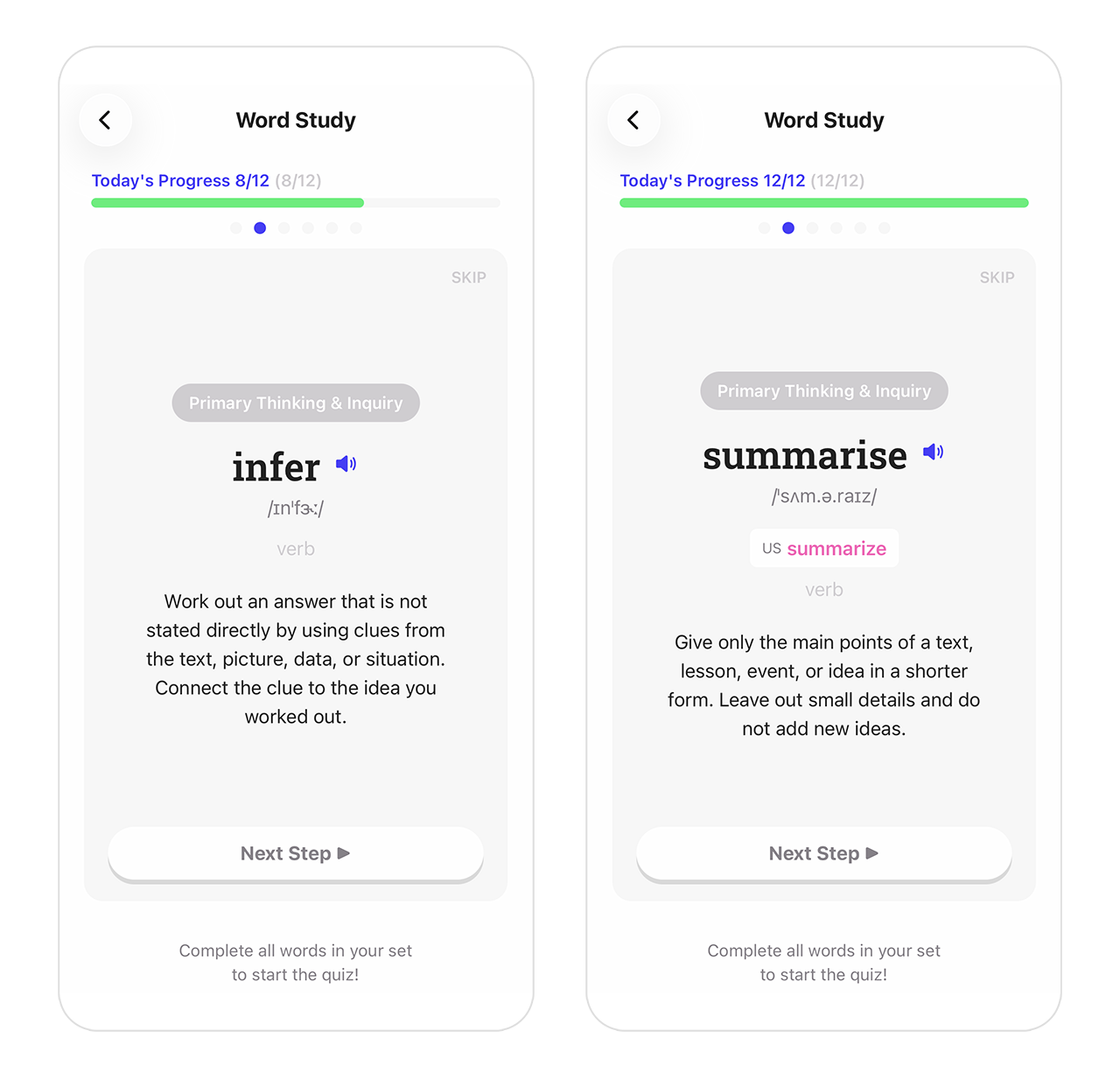
For instructional words, it helps to learn the specific classroom action they ask for.
Primary Vocabulary Leads Into Secondary
Words such as observe, predict, explain, and evidence in Primary later connect to more abstract Secondary vocabulary. A child who is familiar with explain may feel a little less lost when learning justify later, and a child who has often understood observe and predict in class may take in Science words such as hypothesis, variable, and analyse more naturally.
That is why understanding Primary subject vocabulary is not just word memorisation. It is closer to the basic strength children need to keep up with future lessons taught in English.
———
Shall We Try Just 5 Minutes Today?
Choose just two words from what your child has studied and talk about them together.
- What is the basic meaning of this word?
- What action does this word ask you to do in class?
- If this word appears in a question, what should you do?
For example, do not stop at “observe means look.” You can connect it to a real situation: “If you observe a plant leaf, you look closely at its colour, shape, size, and pattern.”
If your child says, “I think this character is angry,” you might ask, “Which part made you think that? That is the evidence supporting your answer.”
———
The point is not to memorise many words at once.
If a child can understand even one word not just as a “meaning,” but as “what to do in class,” it becomes much clearer what to do when reading a question.
It may seem like a small difference, but it can make a real difference in how your child understands lessons.
———
In the next article, we will look more closely at Command Terms that are useful before moving up to Secondary.
Command Terms International School Students Should Know Before Secondary
Share this with someone who might find it helpful